
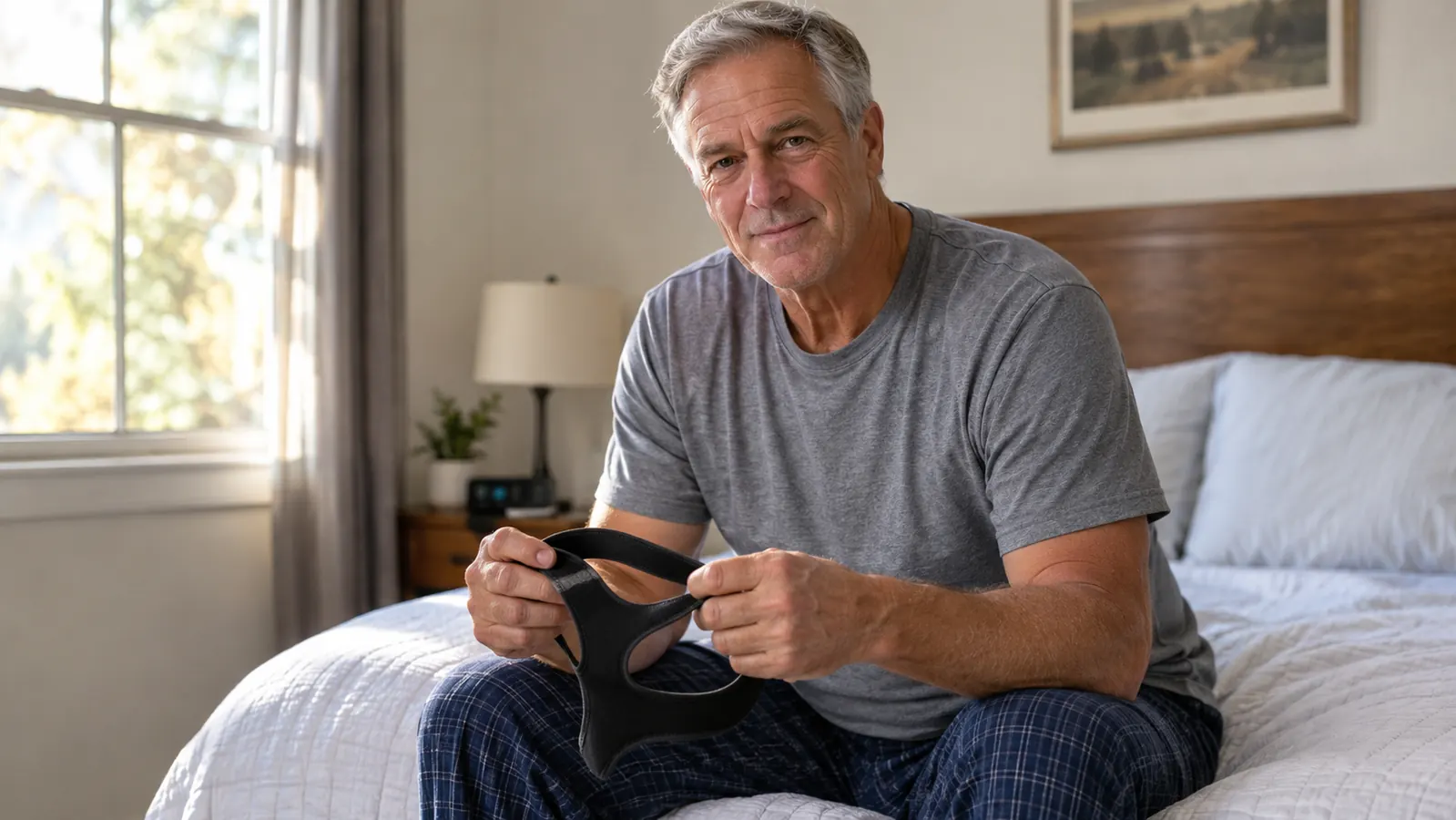
Three years ago I got the home sleep test, the diagnosis and the machine, in that order. Moderate obstructive sleep apnea, a nasal pillow mask, and a wife who finally moved back into the bedroom. That was a good week. What nobody mentioned was how much of the whole thing comes down to small details you end up solving on your own at two in the morning.
The problem for me was my mouth. Somewhere around midnight my jaw would go slack, my mouth would drop open, and the air from the machine would take the easy way out instead of going where it was supposed to. I would wake up with a mouth like the inside of a shoe, on top of the dry air we already get here in Colorado Springs. Tape was the first thing I tried and I did not care for it. A rolled up t-shirt under the chin worked for about an hour. Then a fabric chin strap. The one I have stuck with is the Holinee chin strap, and the reason is not that it does anything dramatic. It is that I could get it comfortable enough to leave on until morning, which turned out to be a completely different problem from getting it on in the first place.
Here is what I wish somebody had told me early. A chin strap is not a device you put on and forget. It is a piece of fabric with an adjustable fastener, and like anything else that sits on your head for eight hours, most of the work happens in the first five minutes and in the small adjustments you make over the first week. Get those right and you stop thinking about it. Get them wrong and you will be awake at three in the morning deciding whether to take it off.
The Strap I Actually Leave On All Night
The Holinee chin strap is a soft spandex and nylon blend with a four-sided wrap and an adjustable touch fastener, so you can set the fit instead of fighting it. It gently holds the jaw where you put it, which is the whole job. Check today's price on Amazon.
Amazon Check Today's Price on Amazon →Step 1: Get Your Sleep Doctor in the Loop First
I want to be straight with you before we go further. Sleep apnea is a medical condition. A chin strap is not a treatment for it. If you are using a strap instead of your machine, or instead of getting a sleep study in the first place, you are doing the wrong thing, and no gadget on a shopping site changes that. I am not a doctor. I am a retired delivery driver in Colorado Springs who snores and who has a machine. What I can tell you about is fit and comfort, and that is the whole of what follows.
The reason to call your sleep doctor anyway is that an open mouth shows up in your leak data, and leak data matters to whether the therapy is doing what it should. Your doctor or your equipment provider can look at your numbers and tell you whether a chin strap is a reasonable thing to try alongside your mask, or whether something else in the setup needs adjusting first. That is one phone call and it is worth making.
I made mine. The answer was that it was fine to try, watch the leak rate for a week, and come back in if the numbers went the wrong way. That is exactly the kind of answer I was after, and I would not have gotten it by guessing.
Step 2: Put the Strap On Before the Mask, Not After
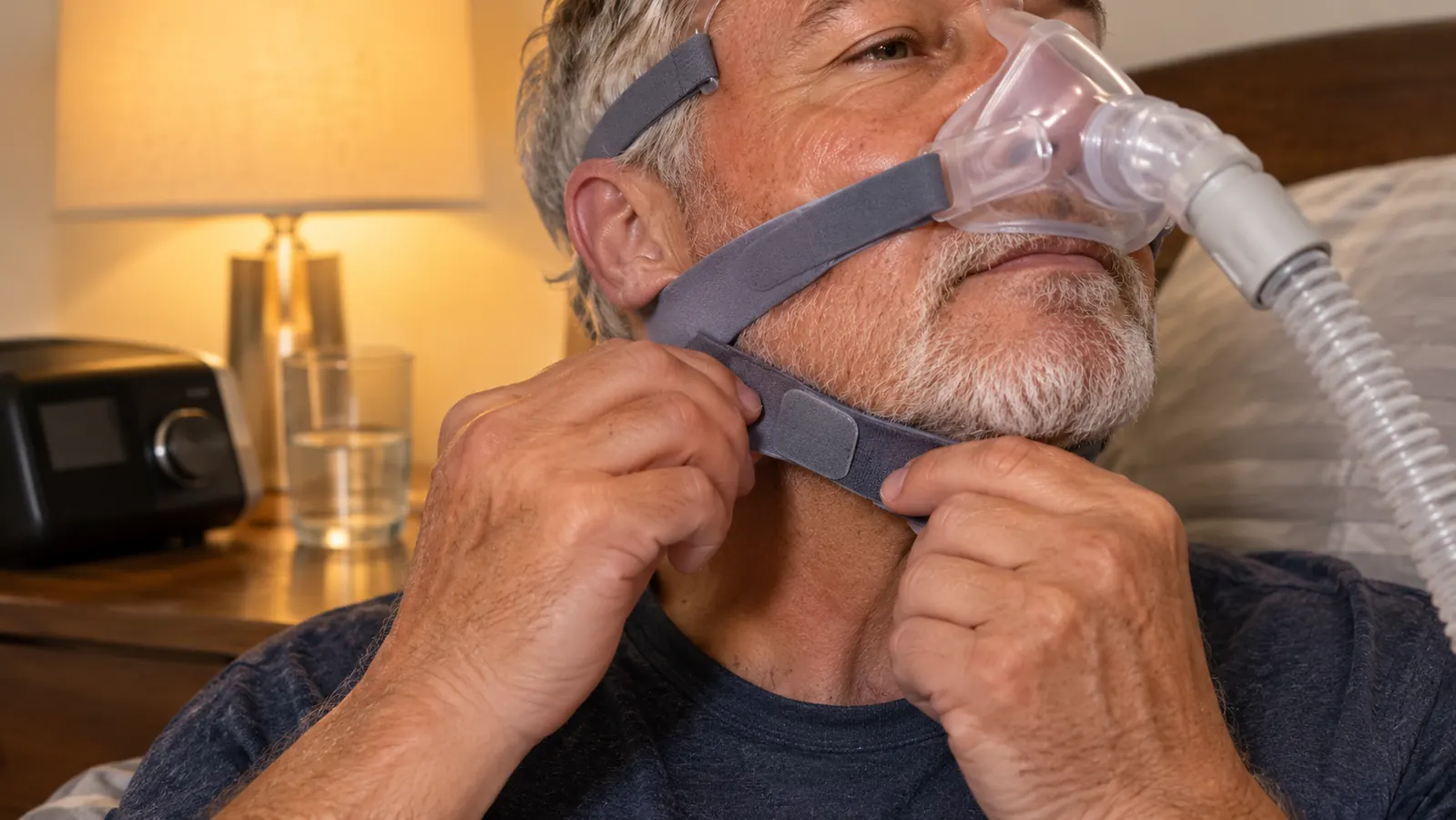
This is the one change that made the biggest difference for me and it took me a week to notice it. I was putting the nasal pillows on first and then working the chin strap into place around them. That meant the strap slid over the headgear, pushed the mask out of position, and started the night with a leak I then had to fix in the dark with my eyes half open.
Do it the other way around. Chin strap first. It wraps under your chin and up the sides of your face, and the touch fastener lets you settle it flat before anything else goes on your head. Then the mask goes on over it. The nasal pillows sit where they are supposed to, the headgear runs over the top, and nothing has to move after that.
The other part of it is where the edges land. The strap should not be underneath the mask cushion or pinched under the headgear straps. If you feel an edge pushing on the side of your nose, or the headgear digging into the strap, take the whole thing off and start again. Two minutes at the start of the night beats twenty minutes at three in the morning, and I have done both.
If you wear a full face mask instead of nasal pillows, ask your provider before you buy one. The strap sits right where the bottom of that mask needs to seal, and whether it helps or hurts depends on your setup, not on what worked for me.
Getting a chin strap comfortable is not about finding the right tightness. It is about the order you put things on and where the edges land. I lost a week to that before it clicked.
Step 3: Set the Tension Lying Down, With Your Jaw Loose
Most people set the strap sitting on the edge of the bed with their chin up and their jaw clenched, then wonder why it feels wrong an hour later. Sitting up, your jaw hangs forward on its own. Lying on your back with your head on a pillow, it drops back toward your throat. Those are two different positions and the strap has to work in the second one, not the first.
So set it lying down. Lie back, let your jaw go slack the way it does when you are drifting off, and adjust the touch fastener from there. Snug enough to hold the jaw in place. Not so snug that you can feel it pulling your chin back. If it is pulling, it is too tight, and it will be the reason you are awake at one in the morning rather than the reason you slept through.
Then test it twice. Once with your mouth closed, and once with your mouth deliberately relaxed open, because that is what actually happens in the night. If the strap holds with your mouth relaxed, it will do the job. If it only works while you are consciously holding your mouth shut, it will not, and you will find that out around two in the morning when it is too late to do anything about it.
Step 4: Deal With Heat, Pressure Points and Hair
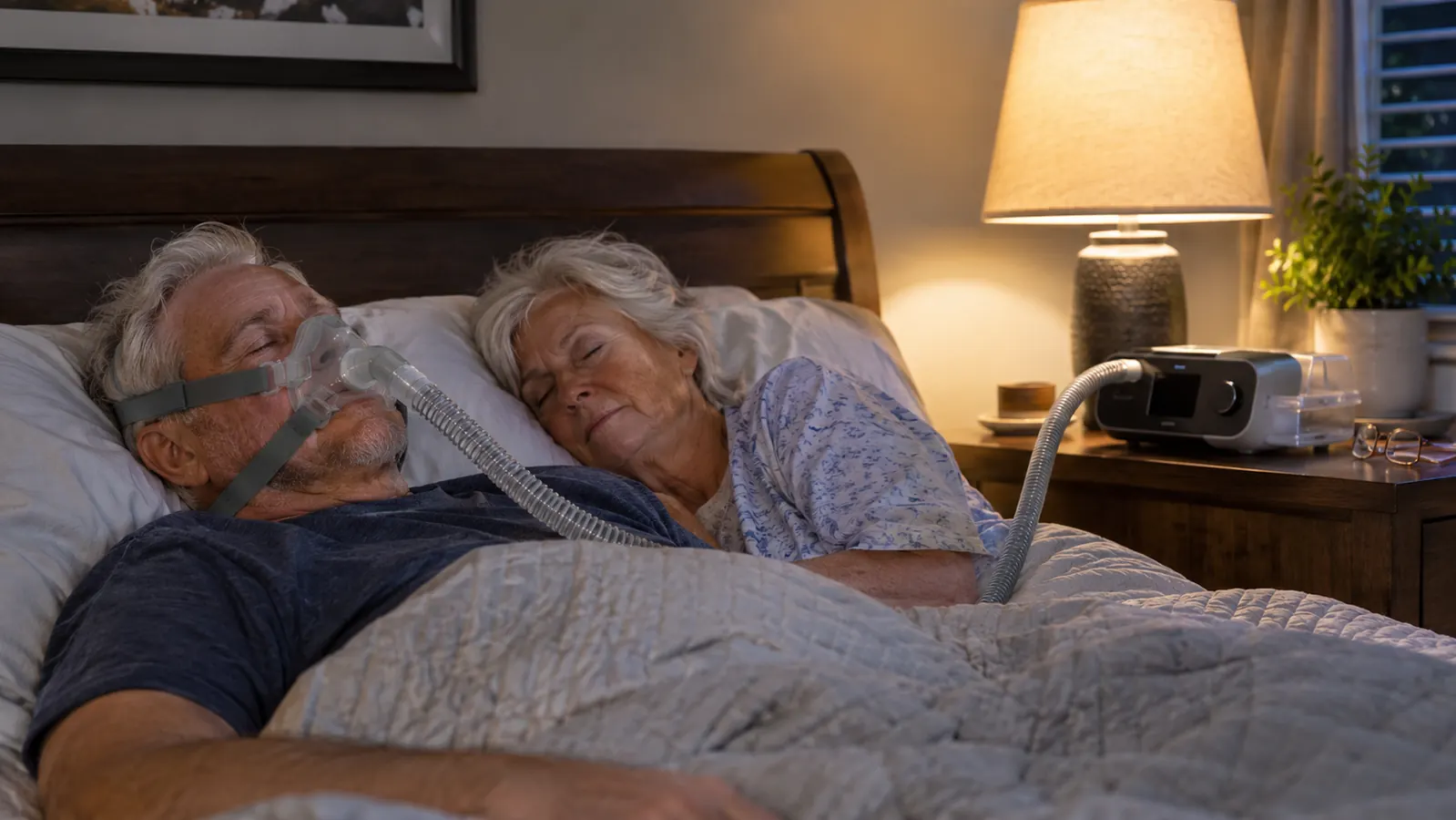
The Holinee strap is a spandex and nylon blend and the listing calls it soft and breathable, which matches what I have found. It is still a piece of fabric wrapped around your head, though, and in a Colorado summer with the windows shut you will notice it. The fix is not complicated. Wash it. I rinse mine in the sink with a little hand soap in the morning and hang it over the shower rod, and it is dry by bedtime. Clean fabric feels cooler, and a strap that has been on your head for a week smells like a strap that has been on your head for a week.
The second thing is where the edges sit. A chin strap rests against skin that does not usually get rubbed, along the jawline and just under the chin. If an edge is sitting on a spot that feels sharp or bony, move it a quarter of an inch. That is the entire point of an adjustable touch fastener. Small moves make the difference between a strap you forget about and one you are aware of all night long.
The third thing is hair. Put the strap on the way you would put on a headband instead of dragging it up your forehead. Linda watched me fight with mine for a week before she pointed that out, and I have not had the problem since. If you have longer hair, tie it back first. Two seconds, and no comedy routine at bedtime.
Step 5: Give It a Week and Read Your Numbers
Do not judge it after one night. My first night, I woke up at some point, took the strap off because it felt strange, and put it back on twenty minutes later because the dry mouth was worse than the strange. That is a normal first week. It does not mean the thing is wrong for you and it does not mean you are doing it wrong.
What I checked each morning was three things. How dry my mouth was. What my machine's leak reading said. And what Linda said, which is the least scientific measure and the most useful one. After about five nights the dry mouth was noticeably better, the leak reading had come down and stayed down, and Linda had stopped elbowing me at two in the morning.
If after a week the numbers are worse, or your mouth is still dry, or you are waking up more than you were before, take it off and call your sleep doctor. It is not for everybody, and there is no prize for sticking with something that is not working.
What Else Helps
A chin strap is one piece of a setup and on its own it will not turn a bad night into a good one. Here is what else made a difference for me, roughly in the order I would do it again.
Humidity first. The bedroom here is dry most of the year, and dry air plus an open mouth is a bad combination. Turning up the machine's humidifier helped more than I expected, and the chin strap helped the humidifier do its job. The two work together, which is not something I understood until I had both in place.
Second, keep the hose where it belongs. A hose cover so the tube is not cold plastic against your arm at three in the morning meant I shifted around less, and shifting around less meant fewer leaks and fewer mask adjustments in the dark.
Third, give anything new two weeks before you decide. The first two weeks of anything new on your face at night are the worst two weeks. If you want a longer look at how this one has held up over months, I wrote that up in my long-term chin strap review, and I also put it next to an adjustable jaw band for anyone weighing the two.
One more thing, and this one matters. Do not stack gadgets hoping the pile adds up. A chin strap, a mouthpiece, a nose strip and a wedge pillow all at once is not a better night, it is a harder one to sort out when something goes wrong. Change one thing, give it a week, then decide about the next.
And two honest complaints, because a review with no complaints is not a review. The touch fastener picks up lint if you leave the strap on the nightstand, so mine lives on the headboard now. And it took me four or five nights to stop fiddling with it. Neither is a deal breaker, but if you expect it to feel like nothing on night one, it will not.
If Your Mouth Falls Open at Two in the Morning
Start with one strap and one week. The Holinee chin strap is soft spandex and nylon with a four-sided wrap and an adjustable touch fastener, so you can set it lying down, where it actually has to work. Talk to your sleep doctor first, then check today's price on Amazon.
Amazon Check Today's Price on Amazon →