
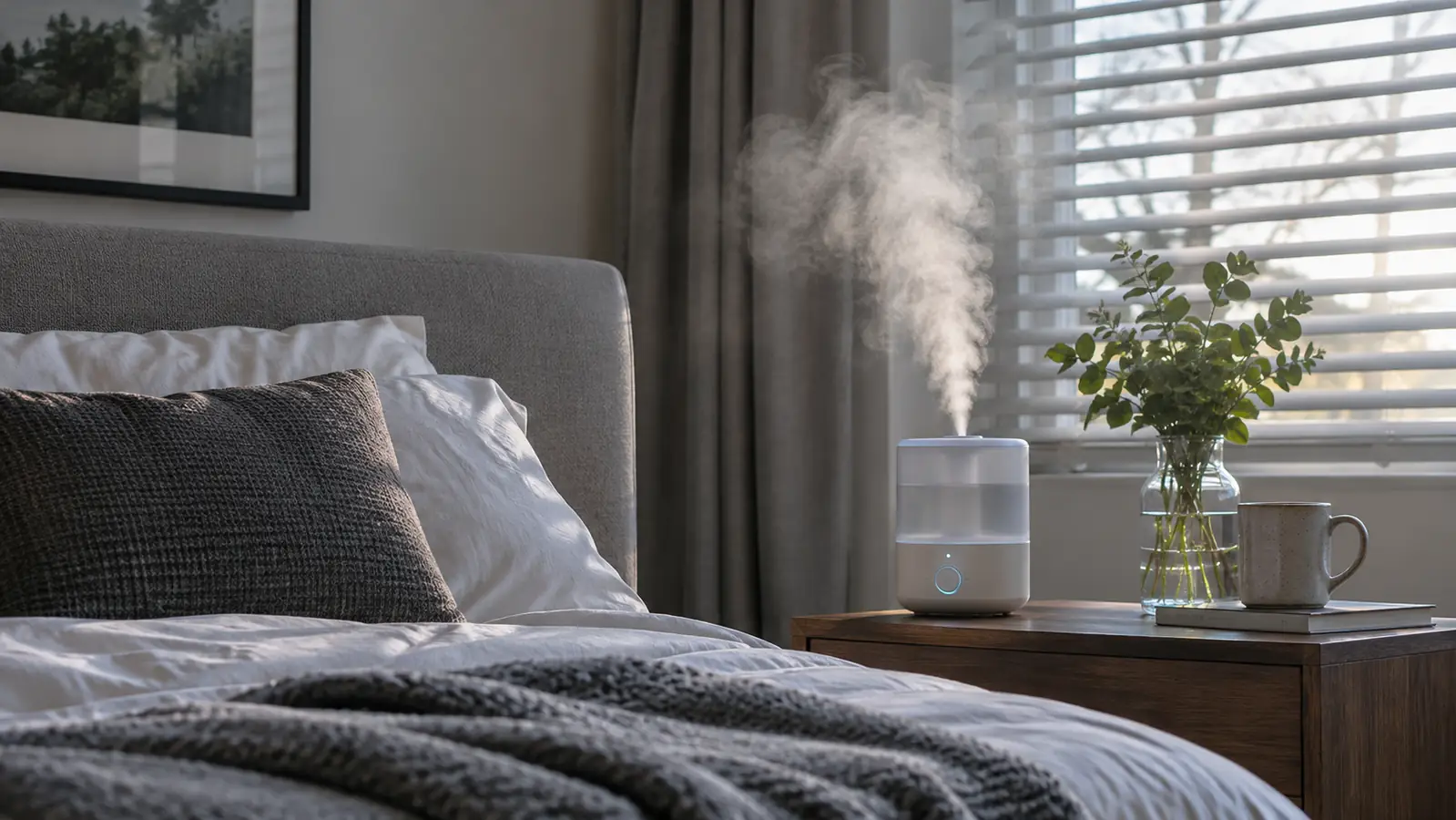
Colorado Springs sits around six thousand feet, and the air up here holds almost no water. Run a furnace from October to April on top of that and our bedroom turns into a desert with a bed in it. For years I woke at two in the morning with my tongue stuck to the roof of my mouth, fumbled for the water glass on the nightstand, and knocked it onto the carpet about one night in three. Linda is a light sleeper. A man who snores and then swears at a spilled glass at two in the morning is not the bed partner she signed up for. I finally bought a Levoit humidifier for the bedroom, and the two in the morning wake-up mostly stopped. It did not fix my snoring. It is not going to fix yours. What it did was take a dry, scratchy, miserable room and make it neutral, and neutral is a big improvement at three in the morning.
Let me be straight about what this thing is. A humidifier puts moisture back into the air of one room. That is the entire job. It will not open your airway, it will not stop a snore, and it is not a treatment for sleep apnea. Apnea is a medical condition. It needs a sleep study and a doctor, and no gadget on a nightstand changes that. What moisture can do is take the edge off the dry mouth, the crusty nose and the tickle in the throat that make an already broken night worse. If you wear a CPAP like I have for about three years, a less dry room is a small mercy on the nights the mask is already irritating you. Small mercy. Real difference.
Fix the Room First, Then Judge the Night
The Levoit Top Fill holds 2.5 liters, runs up to 25 hours on low, and makes about as much noise as a quiet refrigerator. Start with the room. See what the morning feels like.
Amazon Check Today's Price on Amazon →Five Steps to a Night That Isn't Bone Dry
Step 1: Put It Where the Mist Lands Before It Reaches Your Face
Cool mist is heavier than the air in the room, so it sinks instead of rising. That one fact decides where the unit goes. Set a cool mist humidifier on a high shelf and the mist falls past your face on the way down, and you wake up with a damp pillow and a cold nose. Set it low and close and you get the same thing from a different angle.
Mine sits on the nightstand, about two feet from my pillow, with the 360 degree nozzle turned so the mist shoots across the foot of the bed instead of toward my head. The room picks up the moisture over the next hour or so. I do not need to feel it on my face to get the benefit. Frankly I would rather not feel it on my face.
Two things I got wrong at first. I had it flat against the wall, and the paint above it started looking tired, so now it sits a few inches out. And I had it right next to the CPAP machine, which meant the machine's intake was pulling mist straight at the filter. Move it to the far end of the nightstand and that stops. The unit is 6.38 inches deep, 7.12 wide and 10.14 tall and weighs 2.2 pounds, so it takes up less nightstand than the water glass and the CPAP together.
One more: hard surface, not carpet. Sitting on the floor on a rug means the mist goes into the rug instead of the room, and the rug stays damp. Nightstand, dresser, a small side table. Something flat and out of the traffic path, where you will not kick it at three in the morning on the way to the bathroom.
Step 2: Fill It From the Top and Set One Level
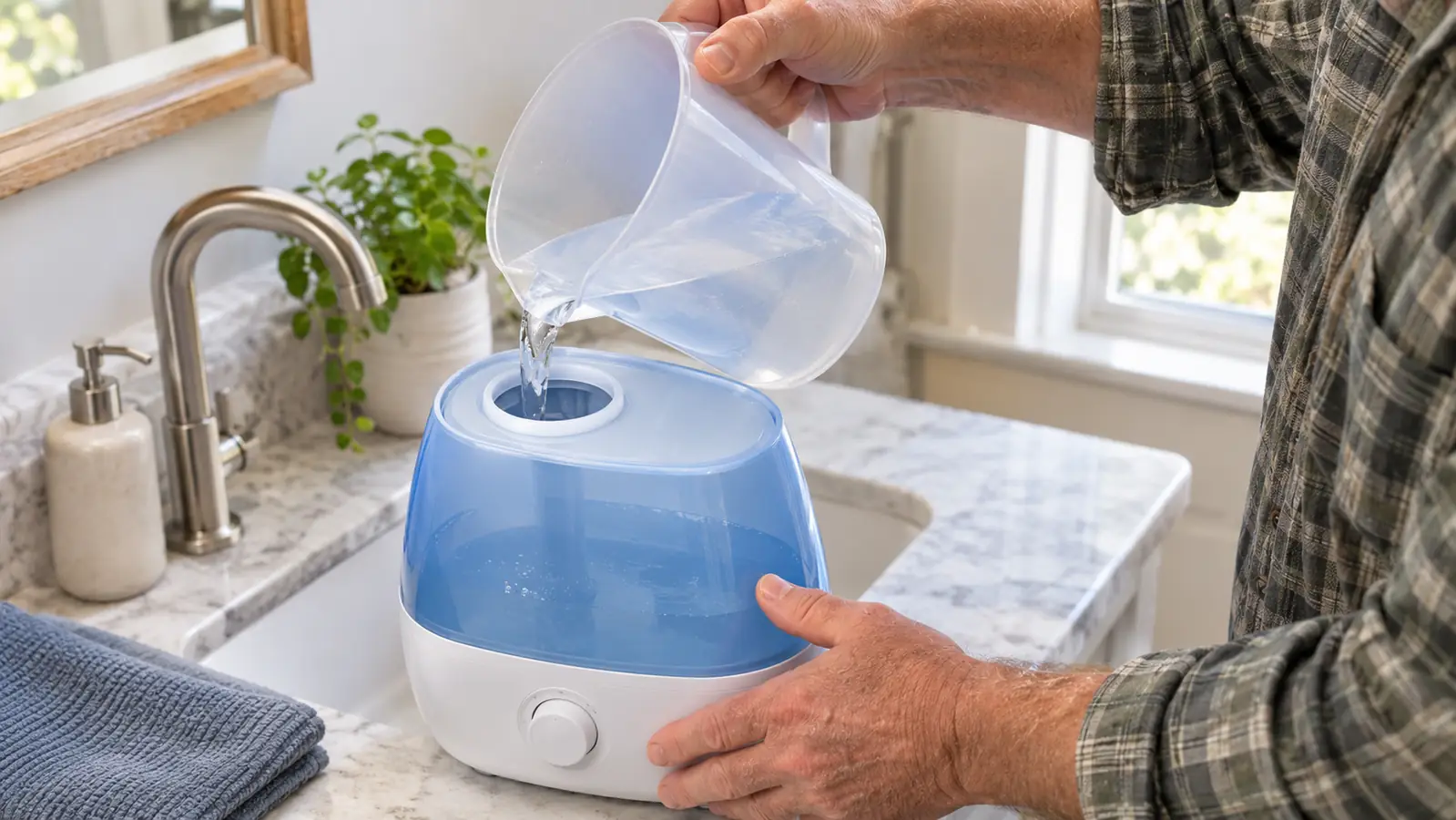
The top fill design is the reason I kept this one. You lift the lid and pour from a pitcher straight into the tank through a wide opening. No flipping the whole unit upside down with a full tank of water, no wrestling the tank out from under the cord in the dark. When your eyes are half shut at ten at night, that matters more than any line on a spec sheet.
The tank holds 2.5 liters, and the listing says that runs up to 25 hours on low. Mine is close to that. I fill it after dinner and it is still going when I get up, which means I am not refilling at midnight in the dark. It is rated for a 219 square foot room, which covers our bedroom with room to spare. If your bedroom is much bigger than that, expect to run it higher and refill it more often.
Mist output is one knob. Turn it up if the air is brutally dry, turn it down if you are getting condensation on the window in the morning. That is the whole control panel. Nothing to program, nothing to pair with a phone at eleven at night. You turn a knob, you go to bed. For a man who once spent twenty minutes trying to get a smart thermostat to accept a schedule, I consider that a feature.
Step 3: Shut the Door and Stop Fighting the Furnace
A humidifier in an open bedroom is working against the whole house. If the door is open and the hallway is dry, you are humidifying the hallway too, just slower and at your expense. Shut the door. Ours stays closed at night anyway, for the light and the noise, so this cost me nothing.
The other half is heat. Crank the thermostat to seventy-two and the air gets drier as it warms, so you run the humidifier harder to fix a problem the thermostat created. We settled on sixty-six at night with an extra blanket, and the humidifier on the middle setting keeps up fine. If your bedroom is colder than you like, add a blanket before you add ten degrees.
A 2.5 liter tank filled after dinner ran from 10:15 at night to a little past 11 the next morning on low. That is the 25 hours Levoit claims, and I have stopped being surprised by it.
Step 4: Get Used to the Sound Before You Judge It
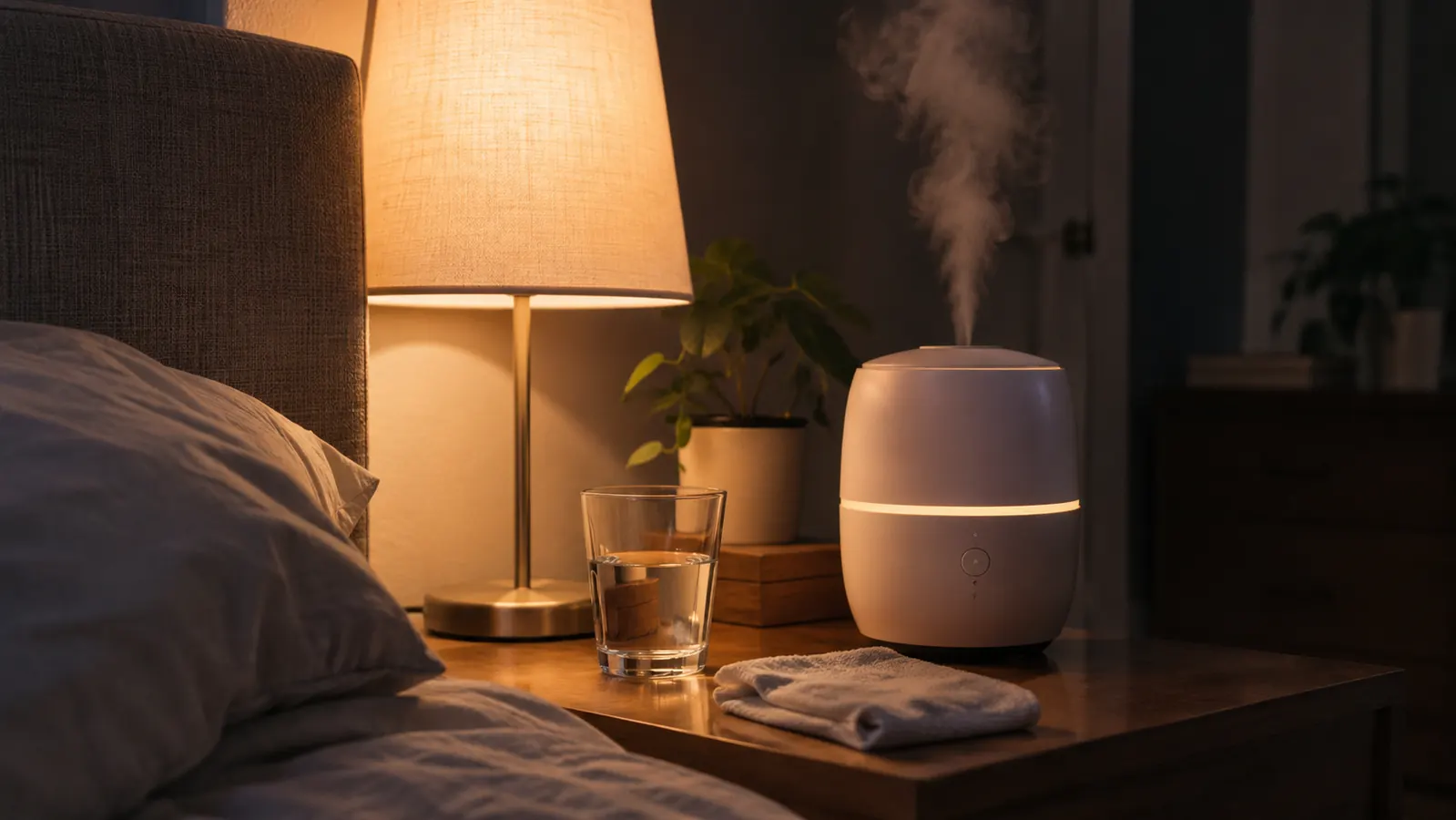
The listing puts this at 25 decibels on the low setting, and that is about right: quieter than the refrigerator, quieter than the furnace kicking on, quieter than the fan Linda runs. It is a soft water sound with a little fan behind it. Some people find that soothing. I found it noticeable for about three nights and then I stopped hearing it at all.
Do expect one thing. When the water runs out, the mist just stops. There is no alarm, nothing to wake you. The first sign is a dry mouth at four in the morning, which is a lousy way to find out. So I made it a routine: pitcher in the bathroom, top it off while I brush my teeth, and the tank has not run dry mid-night since the first week.
Step 5: Clean It on a Schedule You'll Actually Keep
This is where most people quit, and it is the step that decides whether the thing helps you or turns into a science project. Standing water in a warm room grows things. Dump the leftover water every morning and rinse the tank. It takes about fifteen seconds and it is not optional.
Once a week, give it a real clean. The wide top opening is why this is a five minute job instead of a twenty minute one: you can get your hand and the included brush inside the tank. Wipe the inside, rinse the base, and let it air dry with the lid off. There is a water filter sponge in the base that catches grit, and a pre filter that keeps dust out of the works. Rinse both. Do not scrub them to pieces.
If you have hard water, use distilled. Our water is full of minerals, and minerals are what put a fine white dust on the nightstand, the CPAP mask and everything else in the room. I ran tap water for a month and wiped white film off the furniture twice a week. Distilled water ended that. It is a small ongoing expense and it beats replacing a machine that scaled up inside.
And when you pull the lid off to fill it, look at the water you dumped. If it smells like a swimming pool or the inside of the tank feels slick, you skipped a week. Clean it and start the schedule over. That is the whole maintenance speech.
What Else Helps
The humidifier is one piece of this. Here is what else moved the needle in our house. None of it is medical advice. It is what we do, and you should run the medical parts past your own doctor.
A saline nasal spray before bed. My nose was so dry it was cracking, and the humidifier helped but did not seal the deal. The spray is over the counter and cheap and it is worth asking a pharmacist about first. I also keep the water glass on the nightstand, which sounds obvious until you have knocked one over at two in the morning and had to decide whether to get up for a towel.
On the CPAP side, my machine has a heated humidifier built into it, and turning that up made as much difference as anything in the room. That is a conversation to have with whoever set up your machine, not something to fiddle with at midnight on your own. And if you have not had a sleep study, get one. Linda is the one who noticed I stopped breathing in the night. I would have told you I slept fine, right up until the test said otherwise.
Last, a cheap hygrometer from the hardware store takes the guessing out of the knob. I do not chase a number. I just know that when mine climbs past a certain point the windows fog in the morning, and when it drops the dry mouth comes back. That tells me where the knob belongs.
The pattern that works is boring. Door shut, heat down, humidifier running an hour before bed so the air has time to change over, nose sprayed, glass of water on the nightstand. A dry bedroom is not hard to fix. It is just a thing most of us never bother to fix.
I have been running mine on the same routine for a while now: fill it after dinner, knob in the middle, nozzle pointed at the foot of the bed, dump and rinse in the morning. My mouth is not dry at two in the morning anymore and I am not waking Linda up swearing at a spilled glass. She still takes the guest room some nights, but that is about the snoring, and the snoring is a doctor's problem, not a humidifier's.
Start With the Room. The Rest Is a Doctor's Job.
2.5 liters. Up to 25 hours on low. 25 decibels. One knob. It will not treat apnea and it will not stop a snore. It will stop the two in the morning dry mouth that makes everything else worse.
Amazon Check Today's Price on Amazon →