

A wedge pillow is the simplest piece of sleep gear there is. No motor, no mask, no hose. It is foam cut into a triangle. And yet most people who buy one use it wrong for the first two weeks, decide it does not work, and go back to a stack of three pillows that has slid apart by two in the morning. I did exactly that with my first wedge, and I blamed the pillow. The pillow was not the problem. The setup was.
Here is who I am, so you know what kind of advice this is. Hank Morrow, 62, retired long-haul delivery driver in Colorado Springs. Loud snorer for about 20 years. Three years back my doctor ordered a home sleep test and it came back moderate obstructive sleep apnea, which is why I sleep with a CPAP machine and a nasal pillow mask. The Kölbs bed wedge did not replace any of that and it is not meant to. What it did was keep my upper body where the mask needed it, so I stopped waking up at two in the morning with a hose across my neck and a leak whistle in my ear. Getting the thing set up right took about a week of small adjustments. These are those adjustments, in the order I would do them again.
The Foam Triangle That Ended My 2 a.m. Mask Leaks
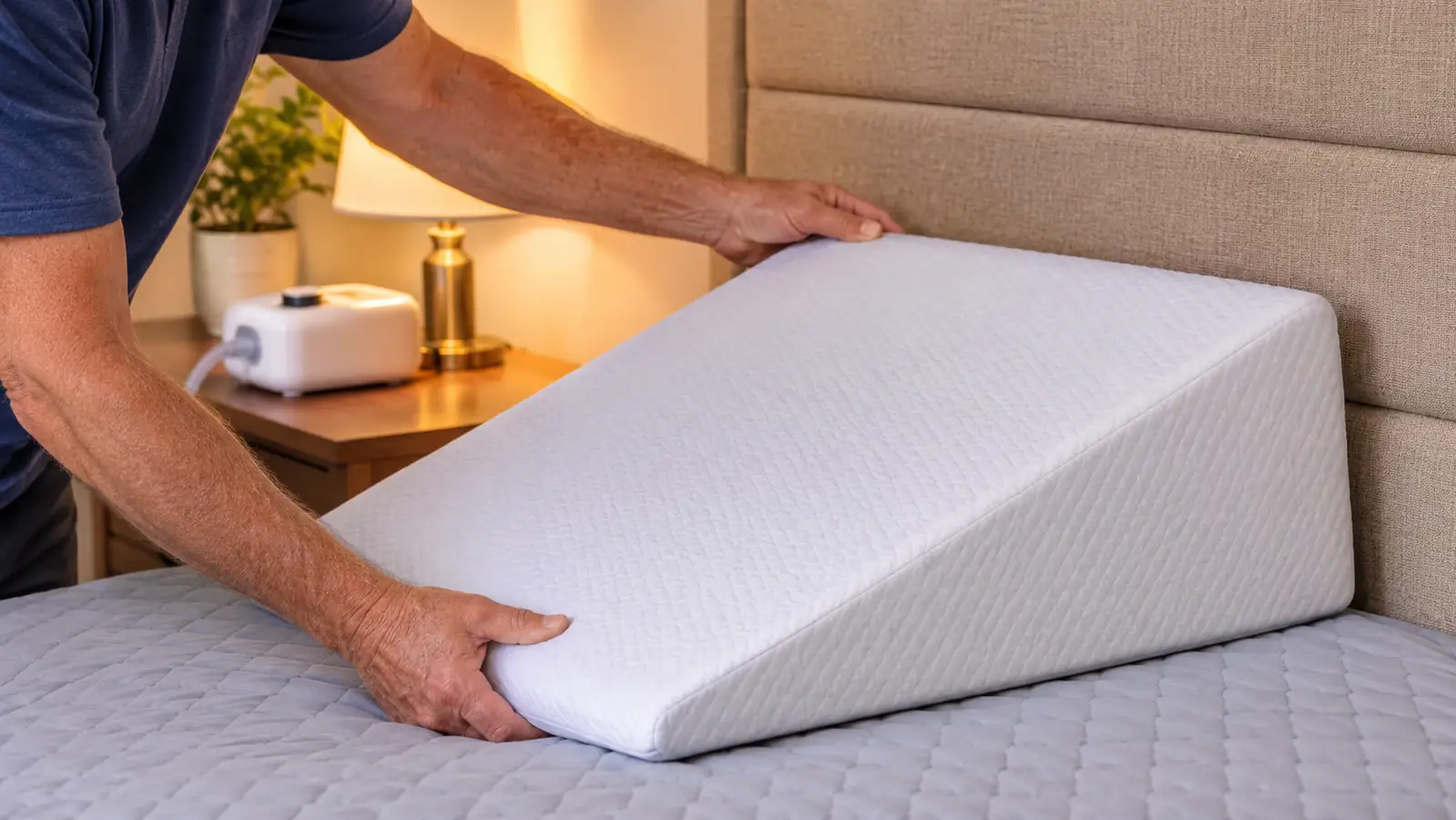
7.5 inch height, 24 by 24 inch base, 1.5 inches of plush memory foam on top and a removable jacquard cover. No app, no settings, no learning curve.
Amazon Check Today's Price on Amazon →The Setup, Step by Step
Step 1: Choose the Height Before You Choose Anything Else
Before I bought anything, I tried the free version for about a month. Three bed pillows in a stack, then a folded blanket under the bottom one to stop the whole thing from sliding. It held for maybe forty minutes. By midnight the stack had walked apart and I was flat on my back again with my chin on my chest, which is the exact position I was trying to get out of. A foam wedge holds its shape because it is one piece. That was the part I had been missing, and it is the part no stack of pillows can copy.
The Kölbs wedge comes in two heights, 7.5 inches and 12 inches. Both are 24 inches long and 24 inches wide at the base in the standard width. Mine is the 7.5 inch. My advice to anyone starting out is to pick the height by how much you want your torso raised, not by how impressive the pillow looks in the product photo. A 7.5 inch lift is a gentle incline. A 12 inch lift sits you up closer to reading position.
You can add a thin pillow on top of a 7.5 inch wedge. You cannot take foam out of a 12 inch one. That asymmetry alone is the argument for starting smaller, especially if you have never slept at an incline before. The first two nights on any wedge feel strange, and it is a lot easier to troubleshoot strange when you have not overshot the angle by five inches.
One thing worth knowing about the build: the top layer is 1.5 inches of plush memory foam over a foam core, with a removable polyester jacquard cover. That 1.5 inches matters more than it sounds like it should, because it lets your shoulder settle in a little instead of perching on a hard edge. It is still a firm wedge. It is not a soft pillow and it will not behave like one at three in the morning.
Step 2: Put It Under Your Shoulders, Not Just Your Head
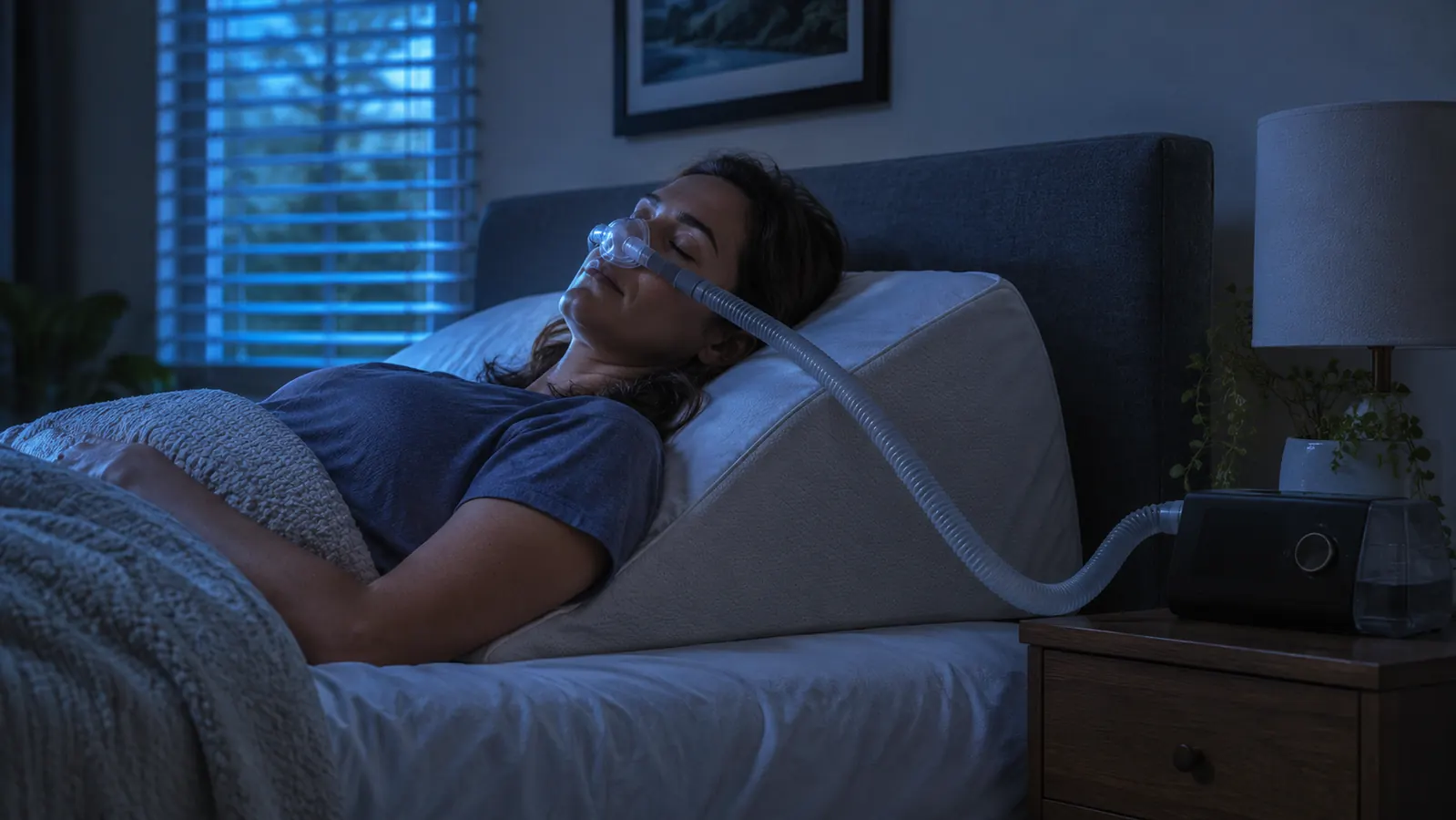
This is the mistake I made for the first four nights. I put the wedge where a pillow goes, flat under my head, so my chin dropped toward my chest and the mask pushed up off my nose. A wedge is not a pillow. It is a ramp for your upper body. The low edge should sit somewhere around your lower ribs or the small of your back, and your shoulders should rest on the slope, not behind it. You want the incline to start behind your shoulder blades, not behind your ears.
Measure once before you settle on a spot. Our queen mattress is 60 inches wide and 80 inches long. The wedge takes 24 inches of that length and it sits on my half only, which is a real consideration in a shared bed. The first night I centered it out of habit and Linda spent the night with an elbow in her back. Since then it lives on my side and neither of us moves it in the dark.
On a queen bed the 24 inch base leaves you room, but check your headboard. I had to slide mine about four inches down from the headboard, otherwise it crept upward every time I rolled and ended up jammed against the wall with me hanging off the bottom of it. If your bed has a footboard, measure the wedge against the length of the mattress before you commit to a position and start sleeping.
Sheets are the other small thing nobody mentions. A fitted sheet stretched over a wedge will pull off by morning. I tuck the flat sheet under the bottom edge and let the top lie loose. The cover itself comes off and goes in the machine, which matters more than it sounds like it should once the thing lives near your face for eight hours a night.
Step 3: Route the Hose So the Wedge Stops Fighting Your Mask
For about three years I used a nasal pillow mask with no incline and woke up most mornings with a red line across my cheek and a dry throat. Some of that was mask fit. Some of it was that I kept curling my chin down toward my chest until the pillows pulled sideways. The wedge cut down on the chin tuck, but only after I stopped running the hose over the top of everything on the bed.
Put the machine on the nightstand at about the same height as your head, or slightly below, and let the hose come up behind the headboard and drop down to the mask. If you run it across the wedge, every time you shift the hose drags and the mask moves with it. I also started putting the mask on before I leaned back, not after. Leaning back with the mask already seated means the cushion settles where it will actually sit all night.
One more small thing that has nothing to do with foam. The connector where the hose meets the mask swivels on most nasal pillow setups. I did not know that for the first year. Once I started letting the swivel take the twist instead of fighting it, turning over stopped yanking the cushion sideways. Check yours before you spend anything on accessories.
If the hose still pulls, a hose lift or even a hook on the wall behind the headboard does more for leak than any pillow adjustment. Not glamorous. It works. I used a spare bike hook for a year before Linda bought me the proper stand.
The pillow never moved. I did. Four inches down the mattress and the hose behind the headboard, and the leaks mostly stopped.
Step 4: Support the Rest of Your Body
An incline changes where your weight sits. On a flat bed you sink in. On a wedge you slowly slide down the slope all night, and by morning you are half off the bottom edge with your lower back complaining about it. The fix is boring: a regular bed pillow under your knees. It stops the slide and takes the pull off your lower back. I have used the same flattened pillow for three years and it does the job better than anything I have bought.
The knee pillow wants to be lower than you think. I tried a molded memory foam knee cushion first and it was too tall, maybe eight inches, which pushed my hips into a new angle and traded one ache for another. A folded bath towel under the knees does the job if you want to test the idea before buying anything. What I use now is a flattened bed pillow, roughly four inches at the fold.
The other gap is the space behind your lower back where the wedge meets the mattress. I roll a hand towel into a cylinder and tuck it in there. Ten seconds of work, every night, and my back stopped stiffening up by Friday. If your neck feels cricked in the morning, the answer is usually a thinner pillow at the top of the wedge, not a thicker one, because the incline is already doing the lifting.
Step 5: Give It a Week and Change One Thing at a Time
Night one on a wedge is not the night to judge it. Your back will notice the new angle, your shoulders will feel like they are sliding, and you will want to quit and go back to the stack. I gave mine five nights before I decided anything, and by night four I was sleeping through the stretch of the night I used to spend fighting the mask. Five nights, no changes, then start adjusting.
What my five nights actually looked like: night one, asleep around eleven, awake at two, gave up and read in the kitchen. Night two, awake at three but back down inside ten minutes. Night three, one wake-up. Night four, none I remember. Night five, none, and Linda said the machine ran quiet. That is not a dramatic curve. It is the honest one.
When you do adjust, change one variable. The position on the mattress, or the knee pillow, or the neck pillow at the top. Not all three at once. Otherwise you will not know which one fixed it and you will be back to guessing by the weekend. I keep a note on my phone for the first week. It sounds fussy. It saved me a month of random changes that told me nothing.
Maintenance is simple. The cover comes off and goes in the washer, the foam core does not. I wash mine about once a month, more in summer. The Kölbs wedge carries a one year manufacturer warranty, which tells you what the company expects its life to be. Mine is over two years old and has not flattened out or gone soft at the low edge, which is where cheap foam usually gives up first.
What Else Helps
Colorado is dry, and our bedroom is drier, especially from November through March when the heat runs all day. A wedge does not fix a dry mouth on its own. A humidifier in the room made a bigger difference to my throat than any pillow did. So did keeping the mask cushion clean and changing the machine filter on schedule. Warm dry air and a clogged filter is a bad combination at this altitude.
The rest is the stuff nobody wants to hear. A late beer makes my snoring worse every single time, and it makes the mask leak more because I sleep heavier. Sleeping on my side for part of the night helps. Keeping the room cool helps. None of it is complicated and none of it is a substitute for the machine on the nightstand.
And one straight answer on the medical side, because it matters more than the pillow does. Sleep apnea is a medical condition. It is diagnosed with a sleep study and managed with a doctor, and for most people with moderate or severe apnea that means a CPAP or another prescribed therapy. A wedge pillow is a comfort item. It can make your sleeping position easier and it can help your mask sit better. It is not a treatment for apnea, and no pillow sold anywhere is. If you snore hard and your partner has heard you stop breathing, get the test before you buy anything at all.
Start With the 7.5 Inch. You Can Always Add a Pillow.
24 by 24 inch base, 1.5 inch memory foam top, removable washable cover, one year manufacturer warranty. Set it under your shoulder blades, not your head.
Amazon Check Today's Price on Amazon →