

The first thing nobody tells you about a bed wedge is that it is not an anti-snoring machine. I bought the Kölbs Bed Wedge Pillow because I am a back sleeper with moderate obstructive sleep apnea, and I kept sliding flat in the night even with my CPAP mask on. Linda, my wife of 34 years, is a light sleeper. She had already spent too many nights in the guest room. I wanted a firmer prop than the stack of pillows I had been wrestling with, and I wanted something I could wash. What I got was a 24 by 24 by 7.5 inch foam wedge with a 1.5 inch memory foam top layer, a removable polyester jacquard cover, and a very specific job. It does that job well. It does not do the job of a sleep study, a doctor, or my CPAP machine.
I have used the Kölbs wedge on a queen bed for several months, mostly on my back. I am 5 foot 11 and 62 years old. The wedge weighs 1.67 kg, so I can move it with one hand, and the cover unzips and goes in the washing machine. Those two details matter more than the marketing copy. A wedge you cannot move or clean becomes clutter. The listing shows 4.4 stars across more than 20,000 reviews, but the average review cannot tell you whether the 7.5 inch height will fit your torso or whether the foam will feel too firm at 2 a.m. That is what this review is for.
The Quick Verdict
A firm, well-covered positioning wedge that helps a back sleeper stay propped up, with two real compromises: the 24 inch length is short for taller users, and it will not replace CPAP or treat apnea.
Amazon Check Today's Price →If you need a firm prop, not a soft pillow, start with the 7.5 inch Kölbs wedge
It is the height I use on a queen bed. Check the 12 inch option only if your doctor or physical therapist has told you to sleep at a steeper angle, because the taller wedge changes how you get in and out of bed.
Amazon Check Today's Price on Amazon →How I've Used the Kölbs Wedge
I put it on top of the mattress, pushed against the headboard, and slept with my upper back and head on the incline. I did not put it under the fitted sheet. I tried that once and the sheet pulled loose by morning. The wedge is 24 inches wide, so it covers the center of a queen bed, not the whole width. Linda had room beside it. The first week I noticed the angle in my lower back before I noticed anything else. The foam is supportive, not sinking. If you are looking for a pillow that cradles your head, this is the wrong object. It is a ramp with a soft top.
My routine is simple. I put on the CPAP mask, lie back on the wedge, and read for twenty minutes. The incline keeps me from rolling flat onto my back in that first hour, which is when I used to get the worst dry mouth. The wedge does not stop leaks around my nasal pillows. It does not make the machine quieter. It just makes the propped-up position more comfortable than a pile of pillows that shifts every time I turn my head. I still wake up sometimes. I still have apnea. The difference is that I am not fighting my bedding at the same time.
The cover is 100 percent polyester jacquard, and it has a little texture to it. It is not slick like a cheap pillowcase. The zipper is covered, so I do not feel it against my shoulder. I wash the cover every two weeks on a cold, gentle cycle and let it air dry. The foam itself does not go in the machine. The listing says machine wash, and I read that as the cover, not the whole wedge. The foam has held its shape. There is a slight compression line where my shoulder sits, but nothing that changed how the wedge works.

The 7.5 Inch Height Is a Compromise, Not a Cure
The Kölbs wedge comes in two heights, 7.5 inches and 12 inches. I chose the 7.5 inch because I wanted a gentle incline, not a recliner. At 24 inches long, the 7.5 inch model rises about as fast as a thick book stack. That is enough to keep my torso angled up. It is not enough to feel like a hospital bed. The 12 inch version is much steeper, and I know myself well enough to know I would have slid down it or knocked it sideways getting out of bed at night. If you have been told to sleep at a steep angle, the taller one may be right. For me, the 7.5 inch is the practical middle.
Here is what nobody tells you about the length. The wedge is 24 inches deep. I am 5 foot 11. When I sit against it with my head near the top, the bottom edge lands around my mid-back, not my hips. That is fine for propping up, but it means the wedge does not support my whole torso. If I slouch down, my lower back finds the mattress again. I had to learn to set my hips back against the wedge and let my upper body take the incline. A taller person may find the 24 inch run short. A shorter person may find it just right.
The height also changes how I get out of bed. I cannot just swing my legs over and stand up the way I did from a flat mattress. I roll to the side first, then sit on the edge. That is not a defect. It is what an incline does. If you have balance problems or get up several times a night, practice the first few nights with a light on and the wedge pushed against the headboard. A wedge that slides out from under you at 3 a.m. is worse than no wedge.
Firmness and the Memory Foam Layer
The top layer is 1.5 inches of plush memory foam over polyurethane foam. That sounds soft. It is not soft in the way a down pillow is soft. The memory foam takes the edge off the foam underneath, and the base does the work. When I press my hand into the center, it gives maybe half an inch before it stops. When I lie on it, my shoulder does not sink through. That is the point. A wedge that bottoms out is just a lumpy pillow with a slope.
The first three nights felt firm. I noticed it across my upper back and between my shoulder blades. By the end of the first week, my body had adjusted, or the foam had warmed and softened just enough. I would not call it plush. I would call it supportive. If you are a side sleeper, this is where the Kölbs wedge will likely lose you. The 24 inch width gives you a place to lie, but the surface does not have a shoulder cutout. Side sleeping on a wedge wants a different shape. I tried it twice and went back to my back.
Memory foam holds warmth. In a Colorado Springs winter, with the heat running and the air dry, I did not mind. In July, I noticed the back of my neck getting warm by morning. The polyester cover does not feel cool. If you sleep hot, plan for that. I put a thin cotton pillowcase over the top section, which helped, and I still wash the jacquard cover underneath. The wedge is 1.67 kg, so adding a pillowcase does not make it hard to move.
What I Liked
- 1.5 inch memory foam top layer over supportive polyurethane foam
- Removable 100 percent polyester jacquard cover is machine washable
- 24 by 24 by 7.5 inch size fits the center of a queen bed
- Weighs 1.67 kg, light enough to move with one hand
- Available in a 12 inch height for people who need a steeper angle
- One year manufacturer warranty
Where It Falls Short
- 24 inch length is short for taller users
- Firm surface is not comfortable for side sleeping
- Memory foam and polyester cover sleep warm
- Does not treat sleep apnea or replace CPAP
- The 7.5 inch angle is subtle, not a steep medical incline
- Can shift an inch or two if you push against it in the night
The wedge did not fix my apnea. It made the propped-up position comfortable enough that I stopped fighting my pillows at 2 a.m., and that is a smaller, more honest claim.
What It Did for My Snoring and What It Did Not Do
I want to be careful here, because sleep apnea is a medical condition. Mine was diagnosed with a home sleep test, and I have used a CPAP machine with a nasal pillow mask for about three years. The Kölbs wedge is not a treatment for apnea. It is not a substitute for CPAP. If you have pauses in your breathing, daytime sleepiness, or a bed partner who hears you stop breathing, get a sleep study. A foam wedge from an online listing cannot tell you whether your airway is closing at night.
What the wedge did was positional. I am a back sleeper. When I lie flat, gravity and my soft tissues do what they do. The wedge keeps my upper body angled up and makes it less likely that I roll flat in the first part of the night. Linda says I am quieter on the nights I use it, but she also says I am quieter on the nights I use CPAP consistently. The wedge did not change my machine readings. It did not lower my events per hour. It gave me a comfortable place to be propped up while the machine did the medical work.
I also noticed less dry mouth some mornings. That could be the angle, the dry Colorado air, the mask, or all three. I am not going to claim the wedge fixed it. What I can say is that I stopped waking up with my head wedged between two flat pillows and my chin tucked toward my chest. That alone was worth the change. If your snoring is simple positional snoring and your doctor has cleared you, a wedge may be a reasonable comfort measure. If you have apnea, it is not the treatment.
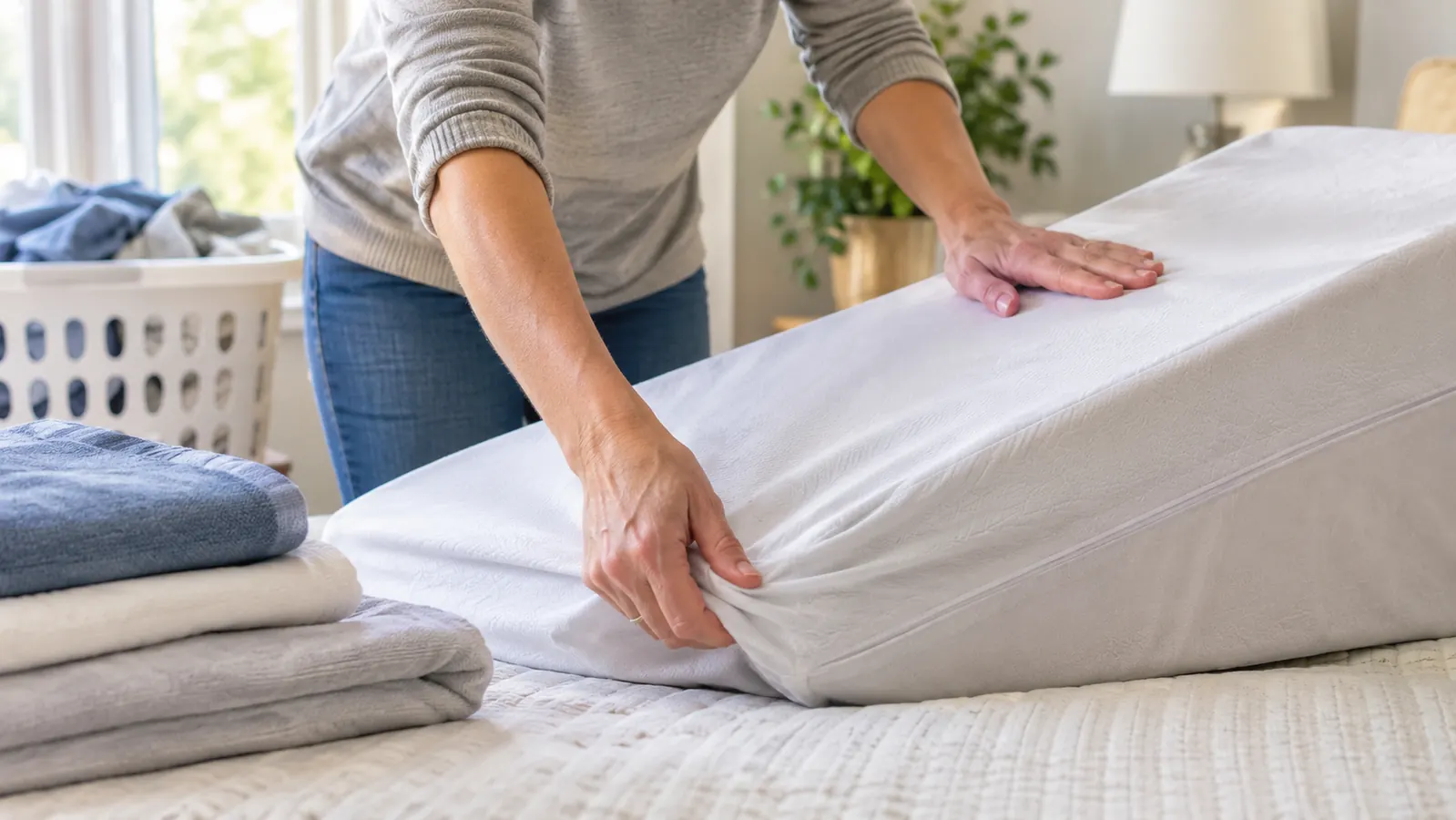
Fit, Cover, and Living With It
The Kölbs wedge is 24 inches wide, 24 inches long, and 7.5 inches high. On a queen bed, it leaves plenty of room for a partner. On a twin, it will take up most of the width. I would measure your bed before you order, especially if you and your partner both use wedges. Two 24 inch wedges on a queen leave 12 inches between them, which is not much. Linda does not use one, so we were fine. If you have a full bed, think about whether you want that much of the sleeping surface taken up every night.
The cover is the part I did not expect to care about. It is a polyester jacquard, and it has a subtle pattern woven in. The listing calls it chic, which is a word I would not use, but it does look less clinical than a bare foam block. The zipper runs along the bottom edge, and the cover comes off without a fight. I wash it every two weeks. The foam has a one year manufacturer warranty. I have not needed it. The foam has not crumbled, and the corners have not gone soft.
Moving it is easy. At 1.67 kg, I can pick it up with one hand and put it in the closet when we have guests. That is also the downside. It is light enough to slide if I push against it. I keep it against the headboard, and it stays put for the most part. On the nights I thrash, it ends up an inch or two off center. I fixed that by putting a folded towel under the bottom edge, which is not elegant but works. If you need it locked in place, plan for that.
Who This Is For
The Kölbs wedge is for a back sleeper who has already been evaluated for snoring or apnea and who needs a firmer, washable prop than a stack of pillows. It is for someone who sleeps on a queen or larger bed and does not mind a 24 inch wide object in the middle. It is for a CPAP user who slides flat and wants a gentle incline, not a steep hospital angle. It is also for someone who wants a removable, machine washable cover and a wedge that weighs less than two kilograms. If you fit that picture, the 7.5 inch model is the one I would try first.
Who Should Skip It
Skip the Kölbs wedge if you are a side sleeper who needs shoulder room, if you are significantly taller than 5 foot 11 and want support down to your hips, or if you want a soft pillow to sink into. Skip it if you have not had a sleep study and are hoping a wedge will fix suspected apnea. Skip it if you need a steep incline, because the 7.5 inch height is subtle. And skip it if you sleep on a twin bed and cannot give up 24 inches of width. The 12 inch version might solve the angle question, but it will not solve the length or the side-sleeping issue.
The honest starting point: the 7.5 inch Kölbs wedge, if you sleep on your back
It is firm, washable, and light enough to move. It is not a treatment for apnea. If you have already been fitted for CPAP and just need to stay propped up, this is the version I use. Check the height and the 24 inch footprint against your bed before you order.
Amazon Check Today's Price on Amazon →