

Linda is a light sleeper. I am not. That mismatch ran our house for about twenty years. She would get up around two in the morning, take her pillow down the hall, and I would find her at breakfast with the flat look of a person who slept four hours in pieces. Colorado Springs does not help. The air here is dry most of the year, the furnace runs from October into April, and I would wake up with a mouth like a paper bag and a nose that felt packed shut. I tried the obvious things. A humidifier in the bedroom. Saline spray on the nightstand. Sleeping on my side until my shoulder filed a complaint. Some of it helped a little. None of it helped enough that Linda moved back down the hall.
The nasal strip was one of the cheap experiments, and I did not expect much from it. Breathe Right Extra Strength is the version I landed on, first because the drugstore had it in stock, and later because the bands are stronger than the original version and stronger turned out to matter for me. I have now used them through the better part of two dry winters, mostly from November to March, and I have a fair feel for what they do and what they do not. What follows is one guy's experience in one dry bedroom. It is not a study and it is not medical advice.
The Quick Verdict
Opens a dry, half-stuffed nose enough to change how the night goes, and the stronger band keeps pulling until morning if the skin under it is clean and dry. It does nothing for sleep apnea, and it is a disposable you buy by the box.
Amazon Check Today's Price →The thing I restock every November
Twenty-six strips in a small box, one a night through the dry months. It is the first thing I reach for when the furnace has been running hard and my nose feels packed.
Amazon Check Today's Price on Amazon →How I've Used It
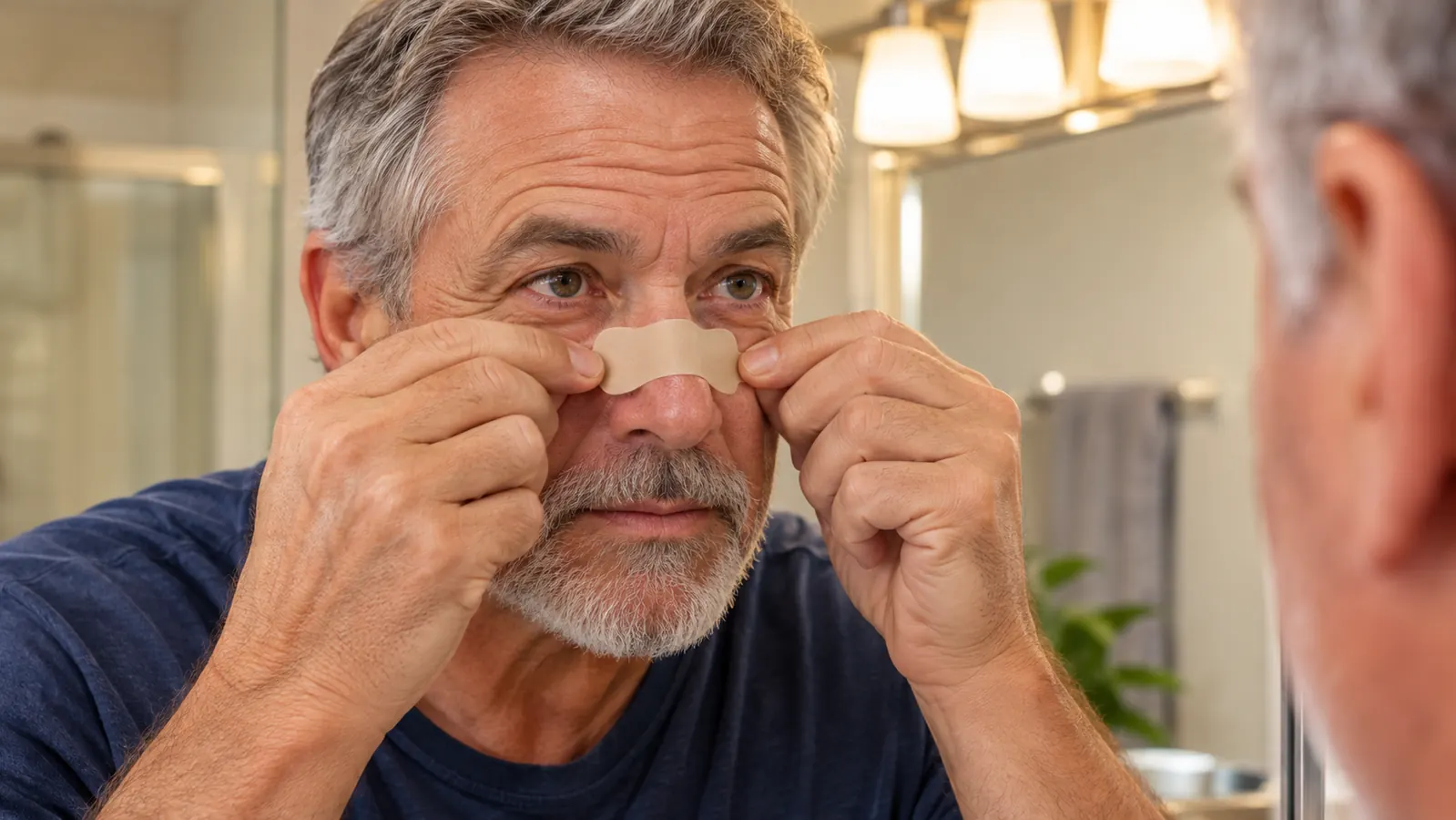
My routine is boring on purpose. Shower first, then a towel across the bridge of the nose, then a minute of letting the skin dry while I brush my teeth. The strip goes on after that, pressed flat for about thirty seconds with both thumbs, starting in the middle and working out toward the ends. If I stick one on ten seconds after washing my face, the corners lift by midnight and I wake up with a strip stuck to my pillow. Clean and dry is the whole method. There is no trick beyond that.
The Breathe Right box holds 26 strips, so a little under a month if you use one every night. It measures about 3 by 1 by 4.13 inches and weighs 1.4 ounces, which means it sits in the nightstand drawer and takes up no more room than a deck of cards, and it slides into a shaving kit without a fight. I buy the larger count now, because I got tired of running out in the middle of a cold snap, and because the small box always seemed to empty itself the week the temperature dropped.
The first week, I noticed the change in my nose more than the change in my sleep. The sides of my nose pulled open and the air felt cooler going in. That sounds like a small thing to write down. It is not small at two in the morning when you have been breathing through your mouth for an hour and your throat is dry enough to rasp. The sleep change came later, maybe eight or nine nights in, when I realized I was waking up with a normal mouth instead of a desert.
I still use my CPAP. I want that on the record early, because the people who read this are either snorers or the partners of snorers, and some of them have heard the pauses. The strips did not replace the machine and I never expected them to. What they did was make the congested nights less miserable. Before, a stopped-up nose meant a rough night on the machine or a rough night off it, and neither one was good. Now the strip is the first thing I reach for when the heat has been running hard.
What the Extra Strength Band Is Actually Doing
A nasal strip is a stiff band with adhesive on the back. The band is bent into a spring shape, and when you press it onto the bridge of your nose it tries to straighten out again. That pull is what lifts the sides of the nostrils and opens the passage a little. Breathe Right puts the Extra Strength bands at 50 percent stronger than their Original strips, and after using both I believe the number. The stronger band pulls harder and it keeps pulling at four in the morning, which the softer one did not do for me.
I started on the Original version because it was there, and because I assumed stronger meant uncomfortable. It was not uncomfortable. It was just weaker, and by three in the morning it had stopped doing much of anything. If your nose is only a little stuffy, the Original is probably enough and it comes off easier. If you are dealing with the Colorado winter combination of dry air, forced heat and whatever the neighbors are burning in the fireplace, the stronger band is the one worth trying first.
The adhesive side matters more than people expect. The Extra Strength strips use a hypoallergenic adhesive, and the material is flexible and non-porous. In plain terms, it holds on skin without much irritation, and it does not soak through when you sweat. I have the kind of face that reacts to bandage glue, the red rectangle that lasts two days, and I have not had that from these in two winters of regular use. That is one man's skin. Yours is different, and a patch test on your forearm is an easy way to find out before you put one on your nose at ten at night.
The sides of my nose pulled open and the air felt cooler going in. That sounds like a small thing. It is not small at two in the morning.
Fit, Adhesion, and the Dry-Air Problem
Fit is where these live or die. The Breathe Right strip comes in one size, and it either spans the bridge of your nose or it does not. Mine is an average nose, and the strip covers it with a little room on each side. A neighbor with a much wider bridge told me he sets his lower, closer to the tip, or the ends curl up on him. If yours keeps peeling, move it down a quarter inch before you decide the product is no good. Placement is adjustable. The strip is not.
Dry air is not the real enemy here. Dry skin is. In January my face gets flaky around the nostrils, and a strip will not hold on flaky skin no matter how long you press it. A little lotion an hour before bed, then a wipe with a warm washcloth right before the strip goes on, solves it. What kills adhesion is oil, and most evening face creams are mostly oil. If you put one on over freshly moisturized skin, you have built a strip that will be on your pillow by two.
Taking the strip off deserves its own paragraph. Pull slow, and pull toward your nose rather than away from it, and it comes free without taking skin with it. Yank one off fast and you will remember the experience. The flexible material moves with your face when you roll over, which is why mine survives the night even though I fall asleep on my back and turn onto my side around four. I have had one come loose in two winters. That one went on over moisturizer, and it was my own fault.
Where It Helped and Where It Didn't
It helped with the dry-mouth wake-ups, and that was the biggest change. Linda noticed it before I did, because a man who sleeps with his mouth open makes a particular noise and then a particular complaint at breakfast, and both of those got quieter. It helped me get to sleep when my nose was half blocked from forced heat. It helped on the two flights I took last year, and I mention that only because airplane air is the same dry air with less legroom, so if you travel a lot it is worth knowing.
It did not help on the nights I had two beers with the neighbors. Alcohol loosens the tissue at the back of the throat, and a strip on the outside of my nose has no opinion about that. It did not help when a cold had me fully blocked, because if nothing is moving through the passage, opening the front of it does not buy you much. It did not touch my apnea. Nothing on a drugstore shelf will, and any package that hints otherwise is selling you a story.
I have also tried the internal dilator kind, the device that goes up inside the nostrils, and that is a different animal. It works on a different principle, it needs washing every morning, and it made me feel like I had a cold coming on all night. The strip is the easier one to live with. Being able to put it on half asleep in the dark is most of the reason I stuck with it instead of the other thing.
The other honest note is the disposability. You are buying one every night you use it, and across a winter that adds up, so it is worth being deliberate about when you actually need one. I use them maybe four nights a week in the dry months and not at all from May to September. That keeps a box lasting most of a season. If you need one every single night of the year, buy the larger count and stop thinking about it.
What I Liked
- Opens a dry, half-stuffed nose within a minute of going on
- The stronger band keeps pulling until morning, which the Original did not do for me
- Hypoallergenic adhesive did not irritate my sensitive skin after two winters
- Small box that fits in a nightstand drawer or a shaving kit
- Works alongside a CPAP on congested nights
Where It Falls Short
- One size, and it will not suit every bridge
- Won't hold on oily or flaky skin, so there is a prep step
- A disposable every night, and the cost adds up over a season
- Does nothing for apnea, for snoring after alcohol, or for a fully blocked nose
- Corners lift if you apply it right after washing your face

The Apnea Question
I snored for twenty years and made jokes about it. Linda is the one who heard the pauses. She said I would stop breathing, then start again with a snort, and after a while she stopped mentioning it because mentioning it did not change anything. My doctor ordered a home sleep test, and it came back moderate obstructive sleep apnea. I have been on a CPAP with a nasal pillow mask for about three years. That machine is the reason I am not falling asleep at two in the afternoon anymore, and no strip on any shelf would have done that for me.
So here is the only rule I will give anybody. If you snore loud enough to wake the house, if your partner hears pauses, if you wake up gasping, or if you are tired all day no matter how long you were in bed, go get a sleep study. A nasal strip is a comfort item for a stuffy nose. It is not a treatment for apnea, and using one does not mean you can put off the doctor. I use both. The strip is comfort. The machine is treatment. Those are different jobs, and I would not want anybody reading this to mix them up.
Who This Is For
This is for the person who wakes up with a dry mouth because their nose is half shut from dry air. It is for the light snorer whose snoring gets worse in January, when the heat runs and the house gets tight. It is for CPAP users like me who want a little help on the congested nights so the mask is not a fight at eleven at night. It is for the partner of that person, the one doing the shopping late, looking for something that might get them back into their own bed. The Breathe Right strip is a small experiment with a short learning curve and no commitment beyond the box.
Who Should Skip It
Skip it if your nose is fully blocked from a cold or from allergies, because a strip opens a passage and cannot clear one. Skip it if you have reacted to adhesives before, or patch test first and find out. Skip it if you have a beard that covers the bridge of your nose, since adhesive and hair do not get along and you will be doing the pulling. Skip it if you are looking for an answer to apnea, because there is not one in this box. And skip it if you cannot stand anything stuck to your face at night, because no amount of benefit will make that feel normal.
If the dry months are the problem, start here
The strip I keep in the nightstand from November to March. One box, one a night, and a short learning curve on getting it to stay put until morning.
Amazon Check Today's Price on Amazon →